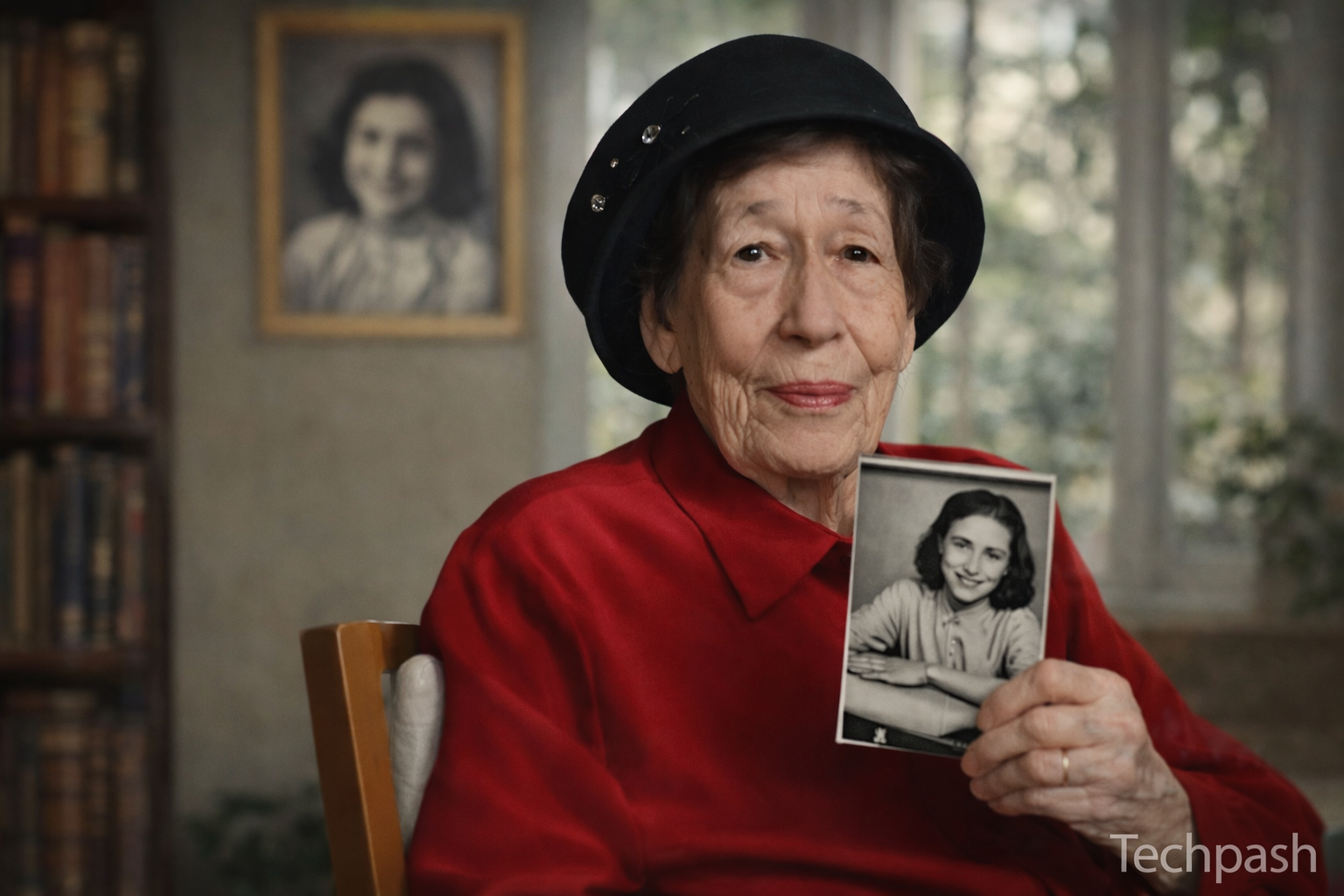
Some lives enter history through fame, while others appear more quietly and still leave a lasting mark. Gabi Goslar belongs to the second kind. Her name is often searched because of its connection to Anne Frank and to Hannah Pick-Goslar, Anne’s close childhood friend. Yet Gabi Goslar’s story stands on its own as part of a larger, deeply human history of war, loss, survival, and memory.
When people look up Gabi Goslar, they are usually trying to understand more than a name. They want to know who she was, how she was connected to one of the most famous stories of the Holocaust, and why her life still matters today. The answer is moving because it brings readers closer to the real families who lived through one of the darkest periods in modern history.
Gabi Goslar was part of a Jewish family whose life was forever changed by Nazi persecution. She was very young during the war, which means her biography is not told in the same public way as that of older survivors who later gave extensive interviews and lectures. Even so, her life remains important because it helps complete the picture of the Goslar family and the world around Anne Frank. In that sense, Gabi Goslar is not just a historical footnote. She is part of a living memory that continues to matter.
Early Life of Gabi Goslar
Gabi Goslar was born into a world that was already becoming dangerous for Jewish families in Europe. Her family had roots in Germany, but like many Jews who saw the rise of Nazism, they sought safety elsewhere. The Goslars eventually lived in Amsterdam, where many German Jewish refugee families tried to rebuild ordinary lives.
At first glance, Amsterdam offered a sense of routine and normalcy. Children went to school, families kept friendships, and neighborhoods formed their own close social circles. It was in this environment that the Goslar family became connected to the Frank family. Anne Frank and Hannah Goslar knew each other well, and their friendship would later become part of Holocaust history.
Gabi, however, was much younger. She was not part of Anne’s school-age circle in the same way Hannah was. That detail is important because many casual accounts online mix up the two sisters. Gabi was the younger child in the family, and her experience of the war was shaped by that vulnerability. She was a small child living inside events too large and cruel for any child to understand.
The Goslar Family During the War
To understand Gabi Goslar’s life, it is important to understand the family around her. The Goslars were not simply names connected to Anne Frank. They were a real family trying to survive under conditions that grew worse each year. Anti-Jewish restrictions spread across daily life. Rights were taken away. Movement became limited. Fear became normal.
For Jewish families in Nazi-occupied Europe, the change was often gradual at first and then brutally fast. The Goslars, like so many others, lived under growing pressure as the occupation turned everyday existence into a struggle. The war did not only threaten public safety. It invaded the private life of the family, reshaping childhood, home life, and every sense of stability.
Tragedy also touched the family personally. Gabi lost her mother at a very young age. That loss alone would have changed the emotional life of any household. During wartime, it became even heavier. A child already surrounded by uncertainty now had to grow up without a mother’s presence. In many ways, this helps explain why the bond between the Goslar sisters became so meaningful.
The Special Bond Between Gabi and Hannah Goslar
One of the most touching parts of the Goslar family story is the bond between Hannah and Gabi. Hannah, who was older, had to carry emotional and practical responsibilities that no child should have to bear. In times of danger, older siblings often became protectors, comforters, and second parents. That appears to have been true in the Goslar family as well.
This relationship gives Gabi Goslar’s biography a deeply human center. History is often told through dates, documents, and famous events. Yet survival often depends on something quieter. It depends on one person caring for another. It depends on family love continuing even when every outside force is trying to break it apart.
For Gabi, being the younger sister meant depending on those around her. For Hannah, it meant carrying a burden of care long before adulthood. This is one reason the Goslar family story continues to move readers. It shows that even in extreme cruelty, tenderness did not disappear.
Deportation and Camp Experience
As Nazi persecution intensified, the Goslar family was eventually deported. Like many Jews in the Netherlands, they were swept into the camp system that tore apart countless families. The family passed through the machinery of deportation that defined so much of the Holocaust.
They were sent to camps, including Bergen-Belsen, which later became known around the world because Anne Frank and Margot Frank also died there. Bergen-Belsen has a distinct place in Holocaust history because of the terrible conditions that developed there in the final phase of the war. Overcrowding, hunger, disease, and despair became part of daily life.
For a small child like Gabi Goslar, survival in such conditions was remarkable. Children were especially vulnerable in camps. They needed food, care, warmth, and protection in an environment designed without mercy. The fact that Gabi survived tells us something not only about chance, but also about the strength of the people around her.
This part of her biography also explains why her story remains significant. Gabi represents the child survivors whose names are not always in school textbooks but whose lives are just as important for understanding the full reality of the Holocaust.
The Anne Frank Connection
It is impossible to write about Gabi Goslar without mentioning Anne Frank, because that connection is what often leads people to search for her name. Still, the connection needs to be explained carefully.
Anne Frank was closely connected to Hannah Goslar, not to Gabi in the same direct way. Hannah later became known for recalling her encounters with Anne Frank in Bergen-Belsen. Those memories are among the most emotional survivor accounts linked to Anne’s final months.
Gabi’s place in that story is quieter, but it is still meaningful. She was the younger sister within the same family, living through the same persecution and sharing in the same fragile hope of survival. In that way, Gabi Goslar helps us see the wider circle around Anne Frank’s world. She reminds us that famous stories are always surrounded by other lives, other children, and other families.
That is why her biography matters. It takes readers beyond a single well-known name and back into the real human network of Jewish life in Amsterdam before and during the war.
Life After the Holocaust
For survivors, liberation was not the end of the story. It was the beginning of another difficult chapter. People who survived had to rebuild from almost nothing. They had to live with grief, trauma, and the challenge of creating a future after immense loss.
In the case of the Goslar family, the surviving sisters moved forward in a changed world. Much public attention later focused on Hannah because she gave testimony and spoke publicly about Anne Frank and her wartime experience. Gabi remained much less visible in public life, which is one reason so many readers today are curious about her.
Yet a quieter public presence does not make a life less meaningful. In fact, it reflects the reality of many survivors. Not all of them became public speakers or memoirists. Many rebuilt their lives privately. They worked, raised families, and carried memory in personal rather than public ways.
That privacy should be respected. It also adds depth to Gabi Goslar’s biography. Her life reminds us that survival does not have to be loud to be important.
Why Gabi Goslar Still Matters Today
Interest in Gabi Goslar has grown because people are increasingly looking beyond the best-known Holocaust figures. They want the fuller history. They want to understand the families around the famous names. They want stories that feel personal and real.
Gabi Goslar matters because she represents the many children whose lives were shaped by the Holocaust but who never became household names. Her biography helps fill in the background of a world too often reduced to a few symbols. She also reminds readers that the history of the Holocaust is not only about death. It is also about survival, resilience, family bonds, and the burden of memory.
There is another reason her story matters now. As the number of living Holocaust survivors continues to decline, every connected life becomes more valuable to history. Lesser-known names are not minor names. They are part of the truth. They help future generations see that the past was lived by countless individuals, each with a face, a family, and a story.
In that way, Gabi Goslar’s biography has a quiet power. It encourages a more complete form of remembrance.
Conclusion
Gabi Goslar may not be as widely recognized as Anne Frank or as publicly documented as Hannah Goslar, but her life still carries deep historical meaning. She was a child caught in one of history’s darkest moments, a member of a family marked by loss and persecution, and a survivor whose story helps us understand the human reality behind famous Holocaust narratives.
Her biography is important because it restores depth to memory. It reminds us that history does not belong only to the most visible names. It also belongs to the children who survived quietly, to the families who held one another together, and to the lives that continued after the world had been broken.
To remember Gabi Goslar is to remember that even the lesser-known lives of history matter. Sometimes, they are the ones that bring us closest to the truth.
