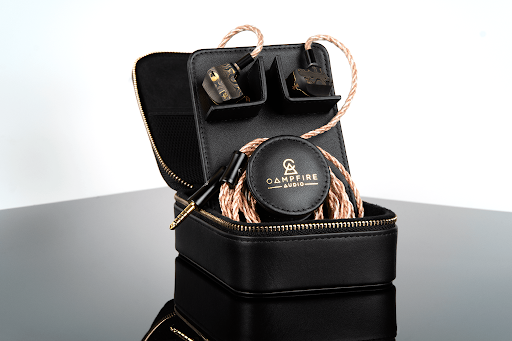
Chimera, Campfire Audio’s current flagship in-ear monitor, contains nine individual drivers inside each earpiece. Those nine drivers span four distinct technologies: dynamic, balanced armature, electrostatic, and bone conduction. None of these technologies is new to audio engineering. Combining all four in a housing small enough to fit in the human ear canal had not been done before.
The product is priced at $7,500. The question is what justifies that engineering complexity, and what it actually achieves.
Four Technologies, One Housing
To understand what Chimera is attempting, it helps to know what these driver types do and why they have historically existed as separate categories.
A dynamic driver is the most familiar design. A small cone attaches to a coil of wire suspended in a magnetic field; audio current makes the coil move, which moves the cone, which moves air. This is the technology inside most consumer earphones and headphones. Dynamic drivers produce bass with a physical, full-bodied character that most listeners find naturally compelling.
Balanced armature (BA) drivers were developed originally for hearing aids, where physical size mattered more than bass output. A tiny paddle suspended between two magnets vibrates when audio current passes through it, producing sound with exceptional precision and efficiency. Multiple BA drivers can be stacked inside a single housing, each assigned a specific frequency range. This is why high-end IEMs often contain several of them: one for bass, one for midrange, one or two for high frequencies.
Electrostatic drivers operate on an entirely different principle. A very thin, electrically charged membrane vibrates between two conductive plates when audio voltage is applied. Because the membrane is extremely light and moves with exceptional speed, electrostatic drivers resolve fine treble detail with a clarity and airiness that neither dynamic nor BA drivers can match at their best. They require dedicated amplification circuitry, which is one reason they appear rarely in compact portable earphones.
Bone conduction drivers bypass the ear entirely. Rather than moving air, they transmit vibration through the bones of the skull directly to the cochlea, bypassing the eardrum. The technology has existed for decades in hearing aids and military communication systems. Its use in high-fidelity audio reproduction is more recent, and its combination with other driver technologies in a single earphone housing is rarer still.
Why Combine All Four?
Campfire Audio’s argument with Chimera is direct: each driver technology has a frequency range and a physical characteristic where it outperforms the others, and assigning the right driver to the right range produces a more coherent and complete listening experience than any single-technology or dual-technology design can achieve.
Chimera’s nine drivers break down as follows. A 10mm True Glass dynamic driver handles the foundation and low-frequency body. Dual-diaphragm balanced armatures cover the midrange. Two high-frequency BAs extend further up the range. Four electrostatic super-tweeters push the treble ceiling far beyond what conventional drivers can reach. A bone conduction driver contributes a layer of physical vibration that no airborne transducer can replicate, adding a sense of presence and spatial dimensionality that distinguishes Chimera from standard IEM designs.
The True Glass driver is Campfire’s own development. Its glass diaphragm is rigid, lightweight, and acoustically neutral, producing a transparency in the midrange and upper bass that more flexible conventional diaphragm materials typically cannot match at the same level of speed and control.
The Engineering Problem
Combining four technologies in a single housing is not straightforwardly additive. Each driver type has different operating characteristics, frequency behaviors, and phase relationships. Getting all nine to behave coherently without introducing resonance problems, tonal inconsistencies, or phase cancellation requires careful crossover design and precise physical placement within the shell.
No production IEM before Chimera had combined bone conduction with electrostatic drivers in the same housing. Integrating them simultaneously with dynamic and BA drivers, in a package small enough for the human ear, is an engineering problem that had not been publicly resolved before Campfire’s team worked through it at their Portland workshop.
A Decade in the Making
Chimera did not emerge without precedent. Campfire Audio introduced its Silicon Dynamic Driver in Axion, becoming the first audio manufacturer to use silicon as a production diaphragm material. That development reflects the same willingness to work with unconventional materials that later produced the True Glass driver in Chimera.
Both advances came from a team that has built IEMs by hand in Portland, Oregon since 2015. The institutional knowledge accumulated over ten years of in-house driver development, material research, and hands-on production is what made Chimera possible. The components were not available off the shelf. The team had to develop the capability to build them.
Chimera and the complete Campfire Audio catalog are available at campfireaudio.com.
